
5 Simple Ways to Make Math Interesting for Children
- Posted by IntelliaSG
- Date April 28, 2026
- Categories Blog
- Comments 0 comment
Many children grow up believing that math is difficult, boring, or something meant only for “smart” students. In reality, math becomes challenging mainly when it is taught through memorization instead of understanding. When children experience math through curiosity, exploration, and real-life connections, it becomes exciting and meaningful.
Here are five simple and effective ways to make math interesting for children.
1. Connect Math to Real Life
Children understand concepts better when they see how math works in everyday situations. Instead of learning numbers only from textbooks, they can explore math through daily activities.
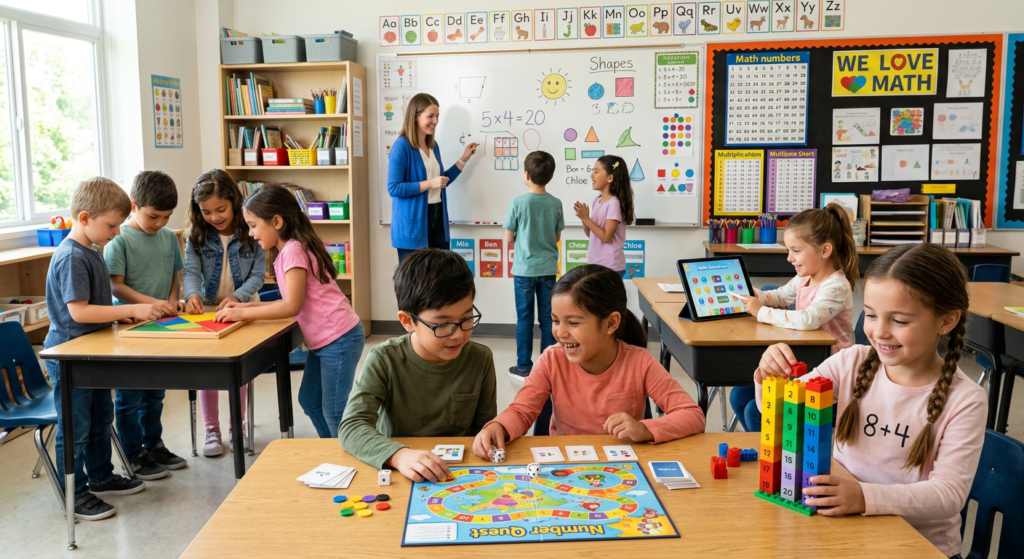
For example:
- Counting fruits while shopping
- Measuring ingredients while cooking
- Calculating time for games or activities
- Splitting chocolates equally among friends
These simple moments help children realize that math is everywhere, making it feel natural rather than abstract.
2. Turn Math into Games
Children learn best when they are playing. Games naturally involve numbers, patterns, logic, and strategy, which makes them perfect for developing mathematical thinking.
You can use:
- Board games involving counting or strategy
- Card games that use addition and subtraction
- Puzzle games that encourage logical thinking
- Interactive digital math games
When learning feels like a game, children become more engaged and motivated to solve problems.
3. Encourage Curiosity Instead of Memorization
A common problem in math learning is focusing only on formulas and answers. Instead, children should be encouraged to ask “why” and “how.”
For example:
- Why does multiplication make numbers grow?
- How do fractions represent parts of a whole?
- Why do patterns repeat in numbers?
When children explore the reasoning behind concepts, they build deep understanding and confidence rather than relying on memorization.
4. Use Visual and Hands-On Learning
Math becomes much easier when children can see and touch the concepts they are learning.
Some effective methods include:
- Using blocks or objects for counting
- Drawing diagrams to understand problems
- Using number lines for addition and subtraction
- Building shapes to explore geometry
Visual and hands-on learning transforms abstract numbers into something children can clearly understand.
5. Celebrate Effort and Problem Solving
Math confidence grows when children feel safe to try, make mistakes, and try again. Instead of focusing only on correct answers, it is important to appreciate the process of thinking and problem solving.
Encourage children by:
- Praising effort and persistence
- Discussing different ways to solve a problem
- Allowing them to explore their own strategies
This builds a growth mindset, helping children see math as a challenge they can enjoy rather than something to fear.
Building a Lifelong Love for Math
Math is not just about numbers or exams. It develops logical thinking, creativity, and problem-solving skills that are valuable throughout life.
When children experience math through games, real-life examples, visual learning, and curiosity, they begin to see it as an exciting adventure rather than a difficult subject.
At Intellia, the goal is to help children understand concepts deeply, think analytically, and enjoy the process of learning math. Because when children truly understand math, they don’t just solve problems — they start to love discovering solutions.

You may also like